What is driving the declines in social cohesion and what can be done about it? How are technological transformations changing the conditions for democratic agency, and what capacity do democratic societies and institutions have to shape these transformations?
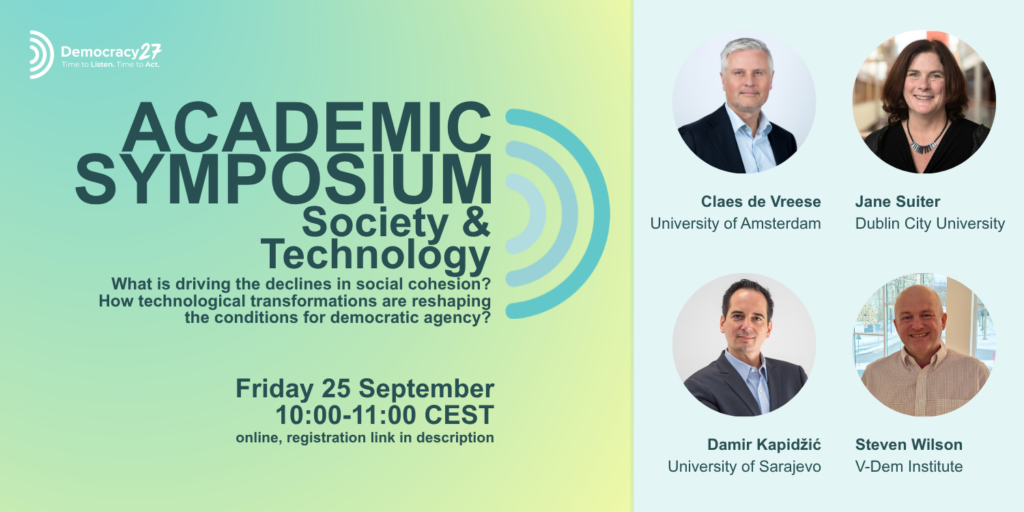
Join Democracy27 next Friday for its first Academic Symposium:
📅 25 September 2026
🕙 10:00–11:00 CEST
💻 Online, Zoom
👉 Register here
With:
- Claes de Vreese – Professor of Political Communication, University of Amsterdam
- Jane Suiter – Professor of Political Communication, Dublin City University
- Damir Kapidžić – Professor of Political Science, University of Sarajevo
- Steven Wilson – Associate Professor, Department of Political Science, University of Gothenburg; Director, V-Dem Institute
Moderated by Democracy27 Task Force member and Academic Advisory Board Chair Prof Dr Madeleine de Cock Buning.
Democratic societies are facing two interconnected sets of pressures: societal fragmentation and technological transformation.
Across Europe and beyond, there are growing concerns about fragmentation, whether linked to changing demographics, evolving identities, a perceived loss of democratic virtues, or broader forms of cultural and social change. Different political perspectives frame these developments in different ways, but concerns about cultural fragmentation and polarisation increasingly shape how citizens relate to one another and to democratic institutions. When disagreement becomes perceived as a threat, the space for constructive democratic debate can narrow, with consequences for trust, participation and social cohesion.
From social media to artificial intelligence, technological transformations are changing the conditions under which democracy operates. Modern digital technologies can expand access to information, enable new forms of participation and amplify citizens’ voices. But they can also reshape who has visibility and influence, fragment public discourse, facilitate manipulation and disinformation, and challenge the ability of democratic institutions to govern rapidly evolving technologies. And there is also a more fundamental question: who has the power to shape the technologies and infrastructures on which democratic life increasingly depends?
The symposium on Society & Technology will bring together, Claes de Vreese, Jane Suiter, Damir Kapidžić and Steven Wilson, leading scholars at the intersection of digital technologies, political communication and democratic governance, to explore how societal and technological change are reshaping the relationship between citizens, institutions, power, participation and social cohesion, and how democratic societies and institutions can respond and shape these transformations. The session will be moderated by Democracy27 Task Force member and Academic Advisory Board Chair Prof Dr Madeleine de Cock Buning.
Join Democracy27 next Friday for its first Academic Symposium:
📅 25 September 2026
🕙 10:00–11:00 CEST
💻 Online, Zoom
👉 Register here