
With:
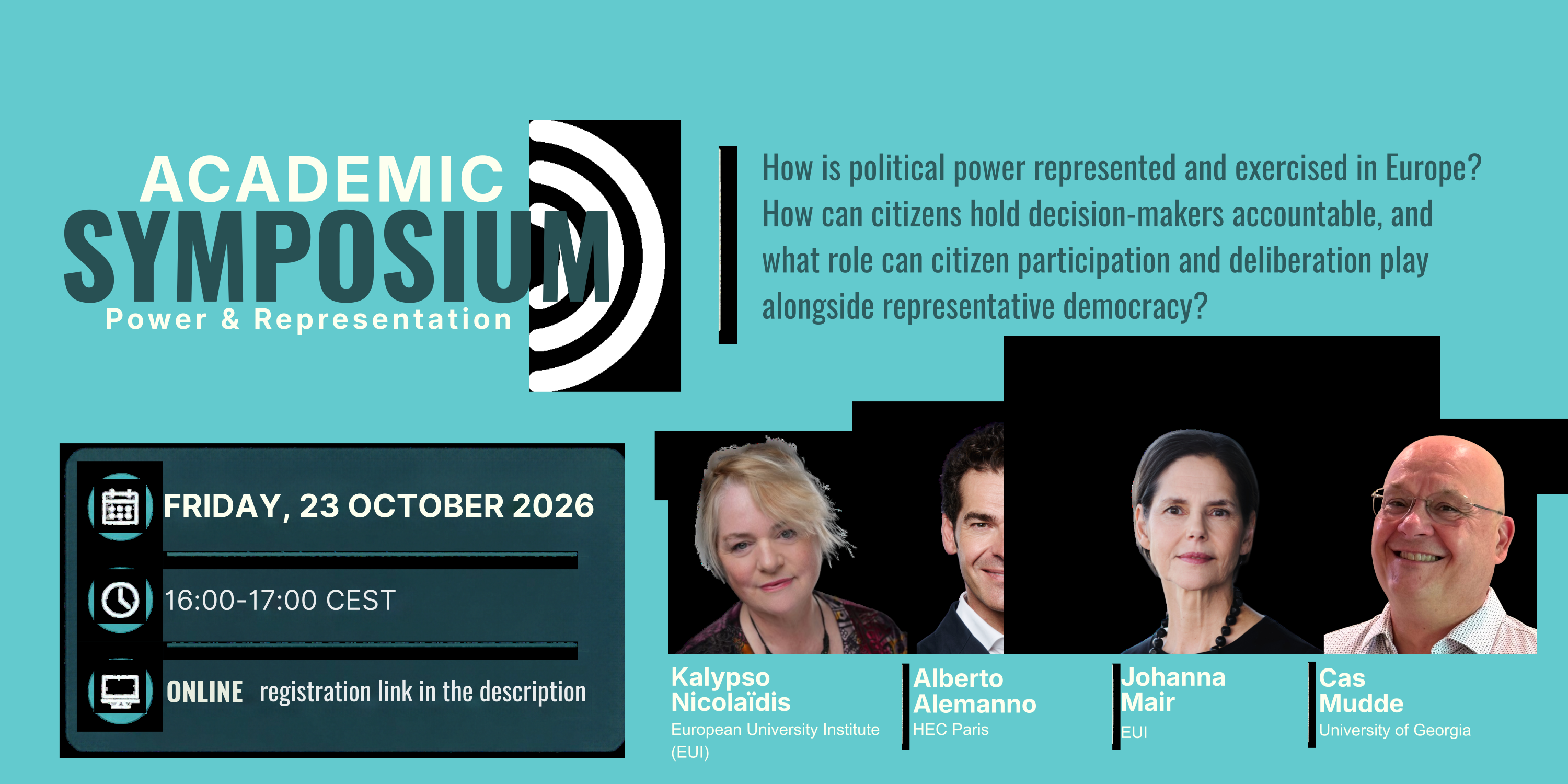
- Alberto Alemanno – Jean Monnet Professor of European Union Law at HEC Paris and founder of The Good Lobby
- Kalypso Nicolaidis – Chair in Global Affairs, Florence School of Transnational Governance, European University Institute
- Cas Mudde – Stanley Wade Shelton Professor of International Affairs, University of Georgia
- Johanna Mair – Director and Professor of Governance, Institutions and Societal Transformation, Florence School of Transnational Governance, European University Institute
Moderated by Democracy27 Task Force member and Academic Advisory Board Chair Prof Dr Madeleine de Cock Buning.
Democratic legitimacy depends not only on who governs, but also on how power is distributed, exercised and held accountable.
Across Europe, questions about political representation are increasingly intertwined with concerns about public trust, unequal access to decision-makers and the growing influence of organised interests. As party systems evolve and traditional forms of political engagement change, questions arise about whose voices are heard, whose interests are represented, and how democratic institutions can remain responsive to the people they serve.
These challenges are particularly complex at the European level, where political authority is exercised across different levels of governance. As European integration evolves, how can democratic values, the rule of law and political rights be safeguarded? And how can citizens meaningfully influence decisions and hold those in power accountable in an increasingly complex political system?
At the same time, democracy extends beyond elections. Citizens’ assemblies, participatory processes, civic organisations and social movements offer additional ways for people to shape public decisions. But what have we learned from the first wave of deliberative experiments? How can these approaches complement representative institutions, strengthen democratic legitimacy and translate citizens’ voices into meaningful political influence?
Join Democracy27 for its second Academic Symposium:
📅 Friday, 23 October 2026
🕓 16:00–17:00 CEST
💻 Online, Zoom
👉 Register here: